

Profit per Employee is One of The Most Underrated Metrics in Business
Welcome to the Dave vs. Startups.
Before we dive in… a quick confession.
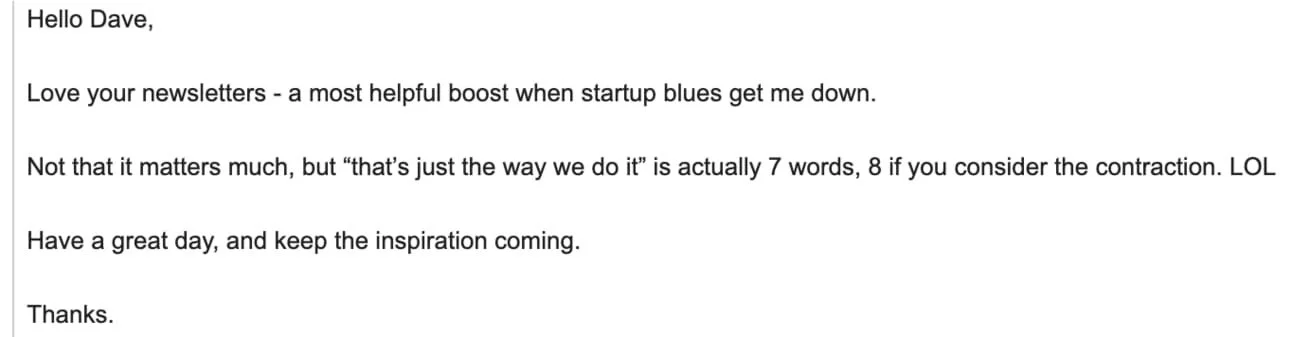
Last week, I said, “That’s just the way we do it” was six words.
Turns out… It’s seven. Or eight, if you count the contraction lol.
(Shoutout to the reader who kindly—and correctly—called me out.)
In my defense: I never promised this newsletter came with a math degree.
Alright, onto this week’s issue…
"Why do you have so few employees for a company your size?"
Potential investors and even customers would ask me this during our AppArmor growth phase.
What they didn't understand was that I'd discovered the one metric that predicts long-term business success better than revenue, user growth, or market share…
Profit per employee.
And it became my North Star.
It's the reason we could bootstrap to a $40M exit without raising capital.
Here’s what it is & how you can apply it to your company:
Early in building AppArmor, I had the typical founder instinct to hire a bunch of people to handle growing demand.
But my brother Chris was obsessed with a different approach, which is maximizing what each person could accomplish.
Here's why the profit per employee metric matters more than revenue:
You can have a million-dollar business with terrible unit economics.
Or… you can have a smaller business that's incredibly efficient and profitable.
The sign of a really good company to me is making a million bucks in revenue with just five people.
That's when I get excited.
This thinking forced me to adopt what I call the AED framework:
Automate, Eliminate, or Delegate (and yes, I borrowed this from Tim Ferriss).
When your business starts growing quickly, you can sweat equity it for a bit.
Work more hours, let your life outside work suffer temporarily.
But that only works short term to get to the next level of systems.
The key insight:
Most founders get trapped working IN their business instead of ON their business.
I see this all the time when I consult with small companies.
The owner becomes an operator who's just trying to keep up, never stepping back to build the systems that would free them up.
I’m a history nerd, so let’s think of it like World War I trench warfare.
You need people in the trenches doing the daily work, but you also need someone above that level trying to find a way out of the quagmire.
That person needs to be developing the first tank.
Which is the breakthrough that makes trenches useless. That's what founders should focus on.
Here's how the growth pattern actually works:
Imagine a chart where you're getting busier and busier, then you introduce a system that makes you less busy.
Then you hit another peak of busy-ness, introduce another system, and reach a new plateau.
The goal is to get systems that reduce your average per-person workload.
That delta between workload and output is profit.
At AppArmor's peak, I had about 20 employees generating $7 million in revenue with 60% profit margins.
Compare that to competitors who raised millions in VC funding but needed huge teams to generate similar revenue.
My profit per employee was astronomical because I built systems, not headcount.
The consulting work I do now reinforces this daily.
I see business owners trapped doing things the same way because “that’s how they’ve always done it”.
Never questioning if they could automate or eliminate that step entirely.
They're operators, not system builders.
The lesson for us…
Revenue growth without profit per employee optimization is just expensive theater.
Focus on building systems that multiply individual productivity rather than just adding more people.
That's how you create a business that's both profitable and sellable.
—————
Is AI Stealing Resilience? The best entrepreneurs learn from their struggles and persevere.
What happens when there's almost no struggle? Chris and I dig into this in the latest episode of the pod.

Tune into the Startup Different Podcast